
The 2026 market for Aluminum Profile For Pergola systems is moving beyond simple shade structures. Homeowners and commercial developers now expect clean lines, corrosion resistance, low maintenance, and reliable performance in changing weather. The International Aluminium Institute reports that global primary aluminium production exceeded 70 million tonnes in 2024, confirming aluminium’s strong industrial foundation. Its sustainability reports also highlight recycling as a major advantage, although energy sources still affect the material’s environmental impact.
Market data supports this shift. Grand View Research identifies construction as one of the leading application areas for aluminium extrusion products. Its industry analysis also emphasizes demand for lightweight, durable, and design-flexible profiles. These findings matter to pergola manufacturers. A slim 6063-T5 or 6063-T6 profile can support modern visual designs, but alloy selection alone does not guarantee quality. Wall thickness, corner strength, drainage channels, fastener placement, and connection tolerances require practical engineering judgment.
Details matter outdoors.
A credible 2026 manufacturer should provide extrusion specifications, coating information, load-test evidence, and traceable quality records. Powder coating standards such as AAMA 2603, 2604, or 2605 may help buyers compare finish performance, but regional climate and installation conditions remain critical. Coastal projects need stronger corrosion planning. Snow regions require careful structural calculations. No ranking is flawless. Supplier claims can look impressive while hiding inconsistent tolerances or weak technical support. This guide therefore evaluates leading manufacturers through material consistency, fabrication capability, testing practices, delivery reliability, customization, and after-sales service. The strongest suppliers do more than sell profiles. They help transform a detailed drawing into a stable, attractive, and serviceable pergola system.
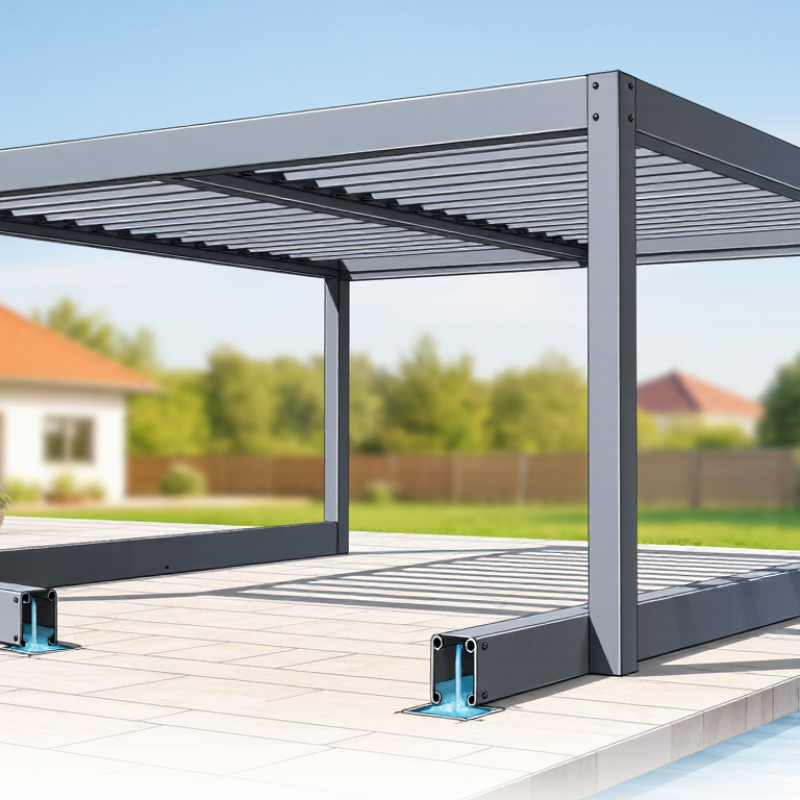
Aluminum profiles for pergolas are engineered sections that form posts, beams, rafters, gutters, and connecting frames. They provide structural support while keeping the roof system relatively light. Most profiles use corrosion-resistant aluminum alloys with suitable temper conditions. However, alloy choice alone does not guarantee durability. Wall thickness, profile geometry, span length, and connection design also affect performance.
Common types include square posts, rectangular beams, T-slots, channels, and custom hollow sections. Extruded profiles can include internal ribs for better stiffness and cleaner cable routing. Key features should include accurate dimensions, smooth surfaces, drainage paths, and stable powder coating. Thermal expansion deserves attention, especially on long outdoor structures. A profile may look strong in a showroom but perform differently after repeated heat, wind, and rain exposure. Manufacturers should verify load data, coating adhesion, dimensional tolerance, and corrosion resistance through documented testing.
Tips: Measure twice. Check the actual installation span before selecting a section. Ask for alloy, temper, wall thickness, and testing records. Keep drainage holes clear during assembly. Do not rely on appearance alone. A small tolerance error can create visible gaps or difficult connections. Designers should also review fastener compatibility and allow movement at expansion joints. Some practical mistakes remain common, including choosing heavier profiles when better geometry would work. That approach increases cost and handling effort without always improving safety.
2026 Top Aluminum Profile For Pergola Manufacturers
How to Evaluate Pergola Aluminum Profile Manufacturers in 2026
A capable manufacturer should provide more than attractive profile samples. Ask for alloy grades, temper details, wall thickness, and dimensional tolerances. These details affect strength, drainage, and installation accuracy. Request engineering drawings showing beam spans, connection points, and water outlet positions. A serious supplier should explain its assumptions clearly.
Inspect the finish under daylight. Look for even color, clean edges, and consistent coating thickness. Ask for corrosion-resistance test reports and batch traceability. Outdoor pergolas face rain, heat, dust, and repeated temperature changes. Thermal expansion deserves attention, especially on long roof profiles. Small gaps can become visible problems later.
Request a sample with actual accessories, not only a loose extrusion. Check whether brackets align without forcing them. Review cutting lists, packaging methods, production schedules, and replacement procedures. Factory quality checks should include profile dimensions, coating appearance, and assembly fit. A supplier that records these checks offers stronger evidence of reliability.
Do not trust perfect photographs alone. A polished sample can hide weak internal ribs or poor drainage design. I have seen projects delayed because a connector fit was assumed, not tested. That mistake is easy to repeat. Compare two or three manufacturers using the same technical checklist. Clear answers matter more than impressive promises, though even careful evaluations can miss a site-specific issue.
2026 Top Aluminum Profile For Pergola Manufacturers
Manufacturing regions strongly influence Aluminum Pergola Profile quality, cost, and delivery speed. China’s Pearl River Delta offers dense extrusion capacity, tooling resources, and competitive production costs. East China is also important for engineered profiles and larger export programs. Turkey provides useful access between European and Middle Eastern markets, while Italy and Germany are known for precise machining and advanced surface treatment. Regional strength does not guarantee performance. Factory capability matters more than location.
A dependable supplier should understand 6063-T5 or 6063-T6 aluminum, profile tolerances, and outdoor corrosion risks. Ask for material certificates, coating test records, and recent load-test data. Powder coating should be checked for film thickness, color consistency, adhesion, and resistance to humidity. Samples reveal details that brochures hide. Look closely at corner joints, drainage channels, screw ports, and cut-edge protection. I prefer suppliers with documented inspections at extrusion, finishing, and packing stages.
Production experience is valuable, but it can become an excuse for slow improvement. Request drawings, inspection plans, and clear replacement procedures before ordering. A factory audit can confirm equipment, storage conditions, and worker practices. Lead time should include tooling, sample approval, production, and shipping, not just extrusion. Some suppliers communicate well but lack testing depth. Others produce excellent profiles yet respond poorly when dimensions change. That weakness deserves careful review. Reliability is built through evidence, not confident promises.
Aluminum profile design determines a pergola’s strength, appearance, and installation speed. Experienced manufacturers begin with span, wind exposure, drainage, and connection loads. Hollow sections reduce weight, while reinforced corners resist twisting during storms. Profiles are not magic. Wall thickness must match the actual span, not only a computer model. Hidden channels can carry LED wiring and rainwater without disturbing the clean roofline. Accurate extrusion tolerances also reduce gaps between beams and posts.
Finishing protects aluminum and shapes the project’s visual character. Powder coating offers broad color control, while anodizing preserves a metallic surface and visible grain. Outdoor specifications should reference recognized coating standards, including AAMA 2603, 2604, or 2605, according to exposure conditions. The International Aluminium Institute reports that recycling aluminum can save about 95% of the energy required for primary production. That makes recycled content a meaningful design consideration, although certification and material traceability still require verification. Small details matter.
Customization can include slimline beams, integrated louvers, concealed fasteners, textured finishes, and profiles for irregular patios. Manufacturers should test drainage, thermal expansion, coating adhesion, and assembly tolerances before mass production. UNEP’s 2024 Global Status Report for Buildings and Construction states that buildings consume approximately 32% of global energy and produce about 34% of global carbon dioxide emissions. Efficient fabrication and durable finishes therefore support longer service life. My practical concern is simple: highly customized profiles may look elegant, but replacement parts become harder to source. Test before scaling.
| Category | Profile Design or Specification | Typical Technical Data | Recommended Pergola Application | Customization Options |
|---|---|---|---|---|
| Primary Alloy | EN AW-6063 aluminum alloy | Common architectural extrusion alloy with good surface finish, corrosion resistance, and extrudability. | Posts, beams, rafters, louvers, gutters, trim, and decorative covers. | Custom profile geometry, wall thickness, internal chambers, screw channels, and drainage paths. |
| Higher-Strength Alloy | EN AW-6061 aluminum alloy | Higher structural strength than 6063 in comparable tempers, with generally less favorable extrusion and finishing characteristics. | Load-bearing brackets, reinforced beams, connection plates, and engineered structural components. | Heat-treatment condition, reinforcement inserts, machining, drilling, and CNC cutting. |
| Common Temper | T5 or T6 heat-treatment condition | T5 is commonly used for extruded architectural profiles; T6 provides a higher-strength heat-treated condition where specified by the design. | T5 for general pergola profiles; T6 for selected structural or highly loaded components. | Temper selection should be confirmed with structural calculations and the extrusion supplier. |
| Profile Shape | Rectangular, square, oval, U-shaped, L-shaped, and custom hollow sections | Hollow multi-chamber sections can improve stiffness-to-weight performance and conceal wiring or drainage components. | Columns, perimeter beams, roof louvers, fascia, and integrated lighting channels. | External dimensions, corner radius, chamber arrangement, rib placement, and concealed fixing grooves. |
| Typical Wall Thickness | Architectural wall thickness selected according to section size and loading | Approximately 1.5–4.0 mm is common for many architectural extrusions; larger structural sections may require thicker walls. | Light-duty trim and louvers at the lower range; posts and beams at the higher range. | Wall thickness can be adjusted to balance weight, stiffness, extrusion feasibility, machining, and cost. |
| Surface Finish | Mill finish | As-extruded aluminum surface without decorative or protective post-treatment. | Hidden components, internal parts, or projects requiring subsequent finishing. | Cutting, drilling, brushing, polishing, anodizing, or powder coating after extrusion. |
| Anodized Finish | Clear, champagne, bronze, or black anodizing | Electrochemical oxide layer that improves surface durability and corrosion resistance. Common architectural anodizing thicknesses include approximately 10–25 μm, depending on specification and environment. | Modern residential and commercial pergolas where a metallic appearance and color stability are desired. | Color, gloss level, anodizing class, masking areas, and post-anodizing cutting or machining requirements. |
| Powder Coating | Exterior-grade polyester powder coating | Typical cured film thickness is commonly around 60–120 μm, subject to the coating specification and application. | Outdoor pergolas requiring a broad color range and a uniform decorative finish. | RAL color selection, gloss level, texture, matte finish, metallic effect, and two-tone color schemes. |
| Wood-Effect Finish | Powder coating with a wood-grain decorative effect | Provides a timber-like visual appearance while retaining the low-maintenance characteristics of aluminum. | Residential gardens, hospitality areas, terraces, and projects requiring a natural appearance. | Wood pattern, base color, texture, gloss, matching accessories, and coordinated fascia panels. |
| Marine or Coastal Use | Enhanced corrosion-protection specification | Requires appropriate alloy selection, pretreatment, coating system, fasteners, drainage, and maintenance planning for salt-laden environments. | Coastal homes, seaside restaurants, resorts, and waterfront terraces. | Coating pretreatment, protective sealing, stainless-steel fasteners, isolated dissimilar metals, and drainage details. |
| Thermal Management | Thermally separated or non-thermally broken profile design | Most outdoor pergola frames use non-thermally broken aluminum; thermal separation may be considered where the system interfaces with conditioned interiors. | Freestanding pergolas, attached patio covers, winter-garden interfaces, and enclosed terrace systems. | Polyamide isolators, insulation pockets, gasket channels, and interfaces with doors or glazing. |
| Roof Louver Profile | Rotating or fixed aluminum louver blade | Blade width, span, pitch, deflection, wind resistance, and water-management performance must be determined for the specific system. | Bioclimatic pergolas, adjustable shade roofs, and rain-protection systems. | Blade width, curved or flat contour, end-cap design, actuator channel, sealing gasket, and rotation angle. |
| Integrated Drainage | Hollow beam with concealed gutter and downspout channel | Directs roof runoff through the frame; drainage capacity depends on roof area, rainfall intensity, outlet size, and fall. | Attached pergolas and louvered roofs requiring a clean, concealed water-discharge system. | Gutter volume, outlet diameter, inspection access, removable covers, and left- or right-hand drainage configuration. |
| Lighting Integration | Internal LED strip channel or cable-management cavity | Concealed channels can protect low-voltage wiring and improve the appearance of the finished structure. | Residential, hospitality, restaurant, and outdoor entertainment areas. | Channel width, diffuser type, access covers, cable exits, sensor openings, and junction-box locations. |
| Fastening Design | Concealed screw groove, T-slot, or external cover system | Allows mechanical connections while reducing visible hardware and simplifying assembly. | Modular posts, beams, louvers, screens, and accessory attachments. | Thread size, groove shape, access direction, cover profile, replaceable caps, and compatible brackets. |
| Fabrication Services | Cut-to-length, drilling, punching, milling, CNC machining, and assembly marking | Pre-fabrication can reduce site work and improve installation consistency when drawings and tolerances are controlled. | Flat-pack systems, project-specific kits, standardized modules, and large-scale installations. | Cutting tolerance, hole position, mitre angle, labeling, protective film, packing method, and assembly sequence. |
| Dimensional Control | Extrusion tolerances based on applicable aluminum extrusion standards | Dimensional requirements should be specified by profile size, shape, wall thickness, straightness, twist, and length. | All custom pergola profiles, especially components requiring interchangeable connections. | Inspection plan, sample approval, critical dimensions, surface acceptance criteria, and batch traceability. |
| Structural Verification | Project-specific engineering review | Wind, snow, dead load, span, deflection, anchorage, foundation, and connection capacity must be checked for the installation location. | Freestanding structures, large-span roofs, attached structures, and areas exposed to severe weather. | Design wind speed, snow load, seismic requirements, span, support spacing, louver position, and local building-code criteria. |
| Quality Documentation | Material certificates, coating reports, inspection records, and technical drawings | Documentation supports traceability and confirms that the supplied material and finish meet the agreed specification. | Commercial developments, public projects, repeat production, and quality-controlled installations. | Alloy and temper certificate, coating thickness report, color sample approval, dimensional inspection, and packing list. |
| Sustainability | Recyclable aluminum profile system | Aluminum can be recycled repeatedly; recycled content and production energy depend on the material source and manufacturing process. | Projects seeking long service life, low routine maintenance, and end-of-life material recovery. | Recycled-content declaration, alloy separation, removable components, repairable parts, and recyclable packaging. |
Note: The values shown are typical industry ranges or design considerations rather than universal requirements. Final alloy, temper, dimensions, finish, coating thickness, tolerances, drainage capacity, and structural performance should be confirmed through project-specific drawings, applicable standards, local building codes, and engineering calculations.
Quality begins with the profile, not the brochure. Experienced buyers inspect alloy grade, wall thickness, dimensional tolerance, and weld-free connections. Common structural alloys, such as 6063-T5 or 6063-T6, offer useful strength and corrosion resistance. However, the correct grade depends on span, climate, and engineering calculations.
Ask manufacturers for material certificates, coating test results, and production inspection records. Powder coating should match recognized regional standards and resist ultraviolet exposure, moisture, and surface chalking.
Check drainage channels, corner joints, fastener compatibility, and load performance under local wind or snow requirements. A beautiful sample can mislead. I have seen thin profiles look impressive before installation.
Pricing depends on more than aluminum weight. Extrusion complexity, alloy cost, tooling, surface treatment, machining, packaging, and freight can change the final figure. Large orders may reduce tooling costs, but minimum quantities still matter. Compare quotations by finished specifications, not price per meter alone. Confirm whether engineering drawings, cutting, accessories, testing, and replacement parts are included.
Request a production sample before approving a full order. Measure the profile with calipers and examine coating consistency under direct light. Review lead times, inspection stages, warranty language, and technical installation documents. Supplier audits add confidence, especially when projects involve coastal air or heavy seasonal weather. A cheaper offer may save money today, but weak drainage or poor tolerances can create expensive corrections later.
One detail is often overlooked: packaging must prevent scratches during long-distance transport.
